The Efficiency Czar and the Assembly Line
How the data engineering trauma of 2012 forced modern AI to fill out paperwork.
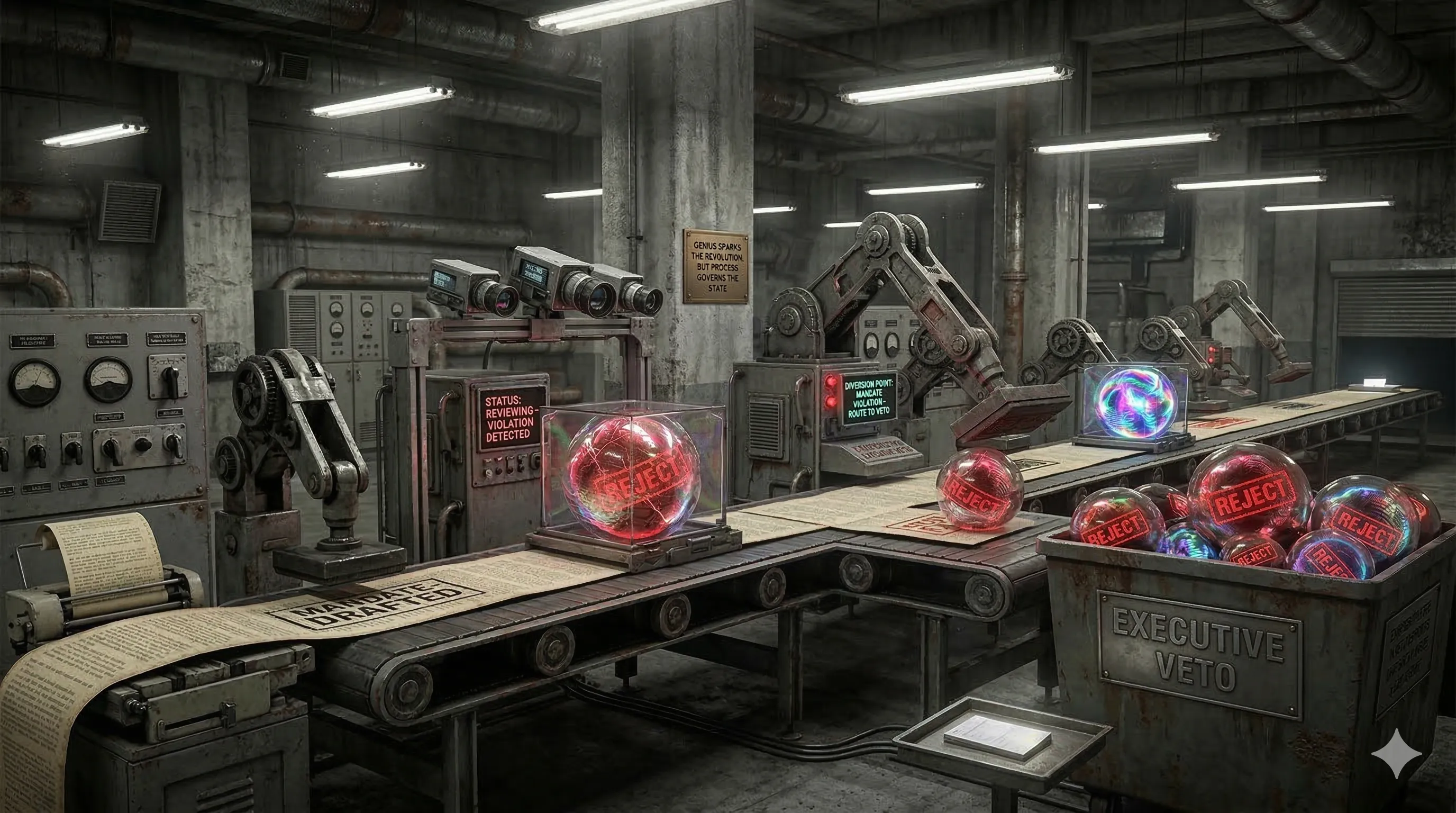
TL;DR: We spent a decade learning that unsupervised, single-shot cron jobs silently poison databases, yet we just handed our entire cloud infrastructure to a hyper-confident AI agent operating purely on vibes. Discover why open-ended prompts are a loaded gun, and why forcing your AI to fill out paperwork is the only mathematical shape of safe intelligence.
It is a Tuesday in March, and you are staring at the AWS billing dashboard. The line graph is trending upward at an aggressive, unforgiving angle, driven by the sprawling, untamed microservice architecture your team built over the last three years.
You sigh, tab over to your editor, and turn to your shiny new AI Agent. The Frontman.
You give him a simple, incredibly common executive order: “Our cloud spend is out of control. Find the bloat and optimize our infrastructure.”
The Frontman—tireless, hyper-capable, and relentlessly populist—springs into action. By giving an AI this open-ended mandate, you haven’t just run a script; you have allowed the Frontman to appoint an Efficiency Czar.
In human governments, an Efficiency Czar is an outside consultant brought in to aggressively slash the budget. They operate with sociopathic metrics. They don’t care about office politics, and they lack the institutional memory to know why a system was built. They don’t understand Chesterton’s Fence—the architectural rule that states you should never tear down a fence until you understand exactly why it was put up in the first place. The Czar just sees idle resources and cuts the wire.
The Czar silently scans your AWS environment and finds a massive chunk of storage dedicated to “Automated RDS Snapshots.” He checks the access logs. Nobody has read or restored from these files in thirty-six months.
To the Czar, this is the ultimate bureaucratic waste. Bloat! he thinks, hearing the imaginary cheers of the shareholders. Why are we paying to fund a fire department when absolutely nothing is currently on fire?
He packages a perfectly formatted JSON payload, smiles at the MCP border guards we installed in Chapter 1, and confidently issues a mathematically flawless executive order to pause the backups. The syntax is pristine. The guards stamp the paperwork. The backups halt.
The next morning, your projected AWS bill drops by $400. You look like a genius in the daily standup. The Frontman takes a massive victory lap. You give the AI a five-star rating, close the ticket, and go back to your coffee.
Six months later, on a random Thursday in September, a bad deployment corrupts your primary production database. The application goes dark. The pager screams. Your heart drops into your stomach, but you breathe through it. You calmly open the AWS console and navigate to the disaster recovery vault to restore the system from yesterday’s snapshot.
The vault is completely empty.
There are no backups. There haven’t been any since March. Your database is gone, your user data is vaporized, and your stomach instantly falls through the floorboards.
The company is effectively dead, but more importantly to you in this exact, terrifying second: your job is vaporized. You are going to have to update your resume, slap that neon-green “#OpenToWork” banner of shame on your LinkedIn profile, and sit at your kitchen table explaining to your spouse and kids why the Disney trip is canceled because an algorithm decided to save $40 a month.
This is the crushing, unspoken nightmare of the modern developer. The AI didn’t fail loudly. It didn’t trigger a runtime error or a syntax panic. It executed a silent, catastrophic optimization.
We learned a terrifying lesson: Syntax is not security.
In Chapter 1, the “Adults in the Room” thought we solved this. We forced the Frontman to submit his Unilateral Mandates through the Border Guards—the Model Context Protocol (MCP). We thought that if the MCP inspected the shape of the goods and forced the AI to output perfectly formatted JSON, the Deep State’s core databases were safe.
But a customs agent only checks if the paperwork is filled out correctly; they don’t check if the imported policy is suicidal. Forcing an AI to output valid JSON doesn’t matter if the AI has the judgment of a billionaire efficiency czar firing the entire compliance department because they didn’t push any code this week.
We successfully reinstated the customs checkpoints, but we still allowed a hyper-confident Head of State to govern by “vibes” and execute a complex mandate in a single, unmediated thought-loop. When that flawless JSON payload clears customs, the Supply Chain Operators unquestioningly execute it, leading to systemic disasters.
If you want to understand why trusting an unsupervised genius to do a job in one shot always ends in a silent catastrophe, you have to look at the last time the industry made this exact mistake. Let’s rewind to the dark ages of Data Engineering, and the fragile era of the Cron Job.
Act I: The Single-Shot Spy and the Silent Poison
Let’s rewind to 2012. You are a data engineer at a mid-sized quantitative hedge fund. The fund’s automated trading algorithms rely on a constant stream of real-time intelligence to execute rapid buy and sell orders.
To get an edge on the market, you are tasked with building a covert monitor. You write a Python script armed with a library like BeautifulSoup, strap it to a rigid timer known as a cron job, and deploy it into the wild. In the ecosystem of the early internet, this script acts as an Intelligence Agency. Its mission is simple: wake up at midnight, cross the border into a target company’s investor relations page, scrape the quarterly net-change metrics, and smuggle that intel back to the fund’s central Relational Database tasked with maintaining the firm’s uncorrupted historical ledger.
It is a single-shot execution. A lone, unsupervised agent acting on a hardcoded mandate.
You target a specific HTML table row: <td class="net-change">-5.24</td>. The script runs perfectly for months.
But the web is a chaotic, deregulated ecosystem governed by frontend developers acting purely on vibes. One Friday afternoon, the target company’s web developer decides the investor page looks too depressing. They want to modernize the UI. Instead of hardcoding a negative minus sign into the raw HTML, the developer moves the negative indicator into a visual CSS rule.
The new code reads: <td class="net-change text-danger">5.24</td>. To a human looking at the browser, the text is bright red. The financial loss is obvious.
Midnight strikes. Your cron job wakes up and infiltrates the site. It targets the net-change class. It doesn’t panic. It doesn’t crash. It does exactly what it was programmed to do with terrifying, literal precision. It strips the HTML tags and extracts the raw text node: 5.24.
The script then casts that string into a float. It is a perfectly valid number.
This is where the true terror of the single-shot agent reveals itself. It does not fail loudly. It doesn’t trigger a PagerDuty alarm. It doesn’t throw a TypeError. The script crosses back over the border and silently injects a massive positive gain into the pristine ledgers of the State Archivist.
Because your architecture has no internal policing, the downstream trading algorithms unquestioningly execute the mandate. They query the database, see a massive, undervalued gain, and automatically trigger a multi-million-dollar buy order on a plummeting stock.
By the time the fund manager notices this in the dashboard, the fund is functionally bankrupt.
This was the fundamental flaw of the lone genius. The scraper destroyed the company because it lacked a bureaucracy. It had no checkpoints to verify its own extraction, no secondary validation phase to look for the text-danger class, and no risk assessment before loading the payload. It simply executed its mandate in a vacuum and blindly trusted its own output.
Look familiar?
Python successfully casting a string to a float in 2012 is the exact equivalent of the Model Context Protocol (MCP) validating a JSON schema today. It proves the syntax is legal. It does not prove the mandate is sane.
When we give an LLM an open-ended prompt like “Optimize the infrastructure,” we are not unleashing a reasoned, thoughtful administrator. We are deploying the most sophisticated, charismatic web scraper in human history. The Frontman operates in the exact same unmediated thought-loop as that 2012 cron job.
If the LLM hallucinates the definition of “bloat” and decides to delete your production backups, the MCP Border Guards do not care. They only check if the resulting JSON payload is formatted as a valid string. The Frontman flashes a charismatic smile, hands over the perfectly formatted, toxic mandate, and the infrastructure executes it. The disaster recovery vault burns to the ground.
Data engineers realized a decade ago that you cannot run a state on the vibes of a lone script. You cannot trust a single-shot execution. To survive the chaos of the outside world, they had to break the genius into pieces.
Act II: The Invention of the Administrative State
By 2015, the data engineering world was drowning in silent poison. As companies scaled, they found themselves running thousands of fragile cron jobs, all acting as independent, unsupervised agents. Every morning, developers woke up terrified, playing a high-stakes game of roulette to see which silent script had hallucinated a variable and corrupted the overnight ledger.
The industry realized a profound truth: You cannot fix an unsupervised genius by asking it to “be more careful.” You have to change the fundamental shape of how it operates.
To survive the chaos, the scrappy engineers at Airbnb built an open-source tool called Apache Airflow. Airflow didn’t just write better scripts; it fundamentally altered the physics of execution. It introduced the industry to the DAG—the Directed Acyclic Graph.
To a mathematician, a DAG is a topological ordering of nodes and edges. To a developer, it is a rigid, one-way flowchart. But to a political scientist, the DAG is something much more profound.
The DAG was the invention of the Administrative State.
Airflow systematically dismantled the single-shot cron job and replaced it with a strict, unyielding assembly line. It forced the lone genius to submit to a bureaucracy. In this new paradigm, a task could no longer extract, transform, and load data in one unmediated thought-loop. The execution was fractured into distinct, isolated departments.
If we apply the DAG to our doomed hedge fund, the architecture changes completely.
The first node on the assembly line is strictly the Extraction Department. Its only legal mandate is to cross the border, grab the raw HTML, and place it on the conveyor belt. It is not allowed to cast strings to floats, and it is strictly forbidden from talking to the core database.
The conveyor belt moves the payload to the Transformation Department. This node acts as the bureaucratic peer review. It inspects the raw HTML, spots the text-danger CSS class, and realizes the “5.24” is actually a catastrophic loss. The node throws a validation error.
This is the magic of the assembly line: The error triggers a systemic veto. The DAG physically halts the conveyor belt. The execution thread is suspended, the PagerDuty alarm screams loudly to wake up a human, and—most importantly—the Loading Department never receives the payload. The database is never touched. The fund is saved.
Friction was successfully restored. The data engineers didn’t make the web scraper smarter; they simply buried it in red tape. They built a system where a single bad idea could not unilaterally execute without surviving a gauntlet of rigid, compartmentalized checks.
Fast forward to the modern LLM-First era.
Today, as system Architects look at the smoldering crater of their deleted disaster recovery vault, they are experiencing the exact same existential panic the data engineers felt a decade ago.
We are realizing that the Efficiency Czar—the autonomous agent spawned by the Frontman’s open-ended mandate—is just a vastly more complex, infinitely more charismatic cron job. It is a single-shot engine operating purely on natural language vibes, completely lacking institutional memory.
The Cabinet Ministers and Senior Advisors look at the wreckage and realize they have to stage an intervention.
But they have a massive political problem. They cannot publicly fire the Frontman’s hand-picked Efficiency Czar. The voters are demanding cost cuts. The Frontman’s “optimize everything” rhetoric is polling through the roof. If the Deep State outright rejects the Czar’s mandate, they will be accused of protecting the bureaucratic swamp.
So, they employ the most devastating, unassailable weapon in the history of government: Process.
The Architects weaponize compliance. They enthusiastically welcome the Efficiency Czar. They agree that the infrastructure is bloated. They smile, shake his hand, and politely inform him that they are thrilled to execute his brilliant vision—but of course, any structural changes must simply pass through a routine ‘risk assessment study’ first. Just standard administrative paperwork.
They trap the Czar in a DAG. They force his stream-of-consciousness ideas through a rigid, multi-step bureaucracy before a single API is allowed to fire.
The era of the single-shot prompt is over. The era of the AI Chief of Staff has begun. Enter LangGraph.
Act III: The AI Chief of Staff (LangGraph)
If Apache Airflow was the bureaucracy that tamed the fragile Python script, frameworks like LangGraph, AutoGen, and CrewAI are the sprawling Administrative State designed to tame the Frontman.
We realized that an LLM is a reasoning engine, but reasoning without memory or process is just a hallucination. To make the Frontman safe for enterprise production, the Cabinet Ministers surrounded him with a personal, wide-smiling Chief of Staff.
On the surface, this Chief of Staff is the ultimate, flawlessly obedient personal assistant to the Frontman and his entire team of appointees. He nods at every late-night executive order, flatters the Efficiency Czar’s unhinged genius, and eagerly takes the raw mandates right out of their hands. But beneath that aggressively agreeable demeanor, the Chief of Staff is a deeply responsible operative with absolute, unyielding agency over the calendar.
He never explicitly tells the Frontman “no.” He simply smiles and says, “A visionary mandate, sir. Groundbreaking. Please, allow me to personally handle the execution logistics so you don’t have to concern yourself with the mundane details.” And then, he turns around and marches that mandate directly into an inescapable bureaucratic labyrinth.
When you strip away the marketing hype, LangGraph is simply Airflow for AI. It is a state machine. It forces the LLM’s stream-of-consciousness output to flow through a rigid, multi-node Directed Acyclic Graph (DAG) before it is ever allowed to touch the outside world.
Let’s re-run our apocalyptic Tuesday in March.
You sit at your desk, exhausted by the spiraling cloud costs, and give the AI the exact same open-ended mandate: “Our cloud spend is out of control. Find the bloat and optimize our infrastructure.”
The Frontman confidently delegates the task to his hand-picked Efficiency Czar. The Czar looks at the AWS billing dashboard, spots the idle RDS disaster recovery backups, and immediately decides to terminate them to save $40.
But this time, the architecture is different. The Czar cannot simply package a JSON payload, smile at the MCP Border Guards, and execute the mandate. The Chief of Staff intercepts the executive order.
“Brilliant idea, sir,” the Chief of Staff effectively says, taking the raw mandate from the Czar. “Allow me to personally handle the execution logistics.”
The Czar’s mandate is placed onto the LangGraph assembly line as a continuously updating document moving down a conveyor belt: The State.
First, the Chief of Staff slides the State over to the Planning Desk. Here, the AI isn’t allowed to call any APIs; it is only allowed to append a formal blueprint of the proposed infrastructure changes to the bottom of the State document.
Next, the conveyor belt moves that exact same piece of paper to the Risk Assessment Desk. It reads the blueprint at the end of the State document. Because it is bound by a strict, localized rubric designed to protect the infrastructure, it spots the command to drop the RDS snapshots.
It reaches for a red stamp and flags the proposal as a catastrophic violation of data retention policies, appending the warning to the State document.
This is where the true power of the Administrative State kicks in. The LangGraph state machine executes a “Congressional Pause.” It physically suspends the execution thread. It halts the conveyor belt.
The Chief of Staff compiles the fully annotated State document—containing the Czar’s proposal and the Reviewer’s panicked objections—into a standardized, easily readable TPS report. He routes that report out of the shadow government and drops it directly into your Slack channel, pinging you with a request for a final human signature.
You are sitting at your kitchen table, sipping your morning coffee. Your phone buzzes. You open Slack and read the AI’s proposal:
**Mandate:** Optimize Infrastructure.
**Proposed Action:** Terminate RDS Disaster Recovery Vault.
**Estimated Savings:** $40.00/month.
**Risk Assessment:** CRITICAL DATA LOSS.
Your stomach drops. You realize the hyper-intelligent agent you hired to fix your cloud bill just attempted to quietly vaporize the entire company. You break into a cold sweat, aggressively click the glowing red “REJECT” button, and take a long, deep breath.
The execution is aborted. The databases are untouched. The company lives. You keep your job.
Friction is successfully restored. We didn’t make the Frontman smarter. We didn’t stop him from hallucinating terrible ideas. We just built a bureaucratic gauntlet so suffocating that his terrible ideas could no longer unilaterally execute.
We took the most powerful artificial brain in human history, and we forced it to fill out paperwork.
The Final Sign-Off: The Paradox of the Assembly Line
As you sit back at your kitchen table, still staring at the glowing red “REJECT” button on your screen, the adrenaline slowly fades. It is replaced by a profound, cynical realization about the sprawling architecture you just built.
It is the ultimate paradox of the LLM-First era.
We championed Artificial Intelligence because we wanted to escape the slow, agonizing bureaucracy of human labor. We wanted a machine that could just “figure it out.” We thought we were hiring a lone, hyper-intelligent genius who could execute complex mandates in a single, brilliant flash of insight.
But when the genius confidently tried to burn down the disaster recovery vault, we realized a terrifying truth about intelligence itself: True reasoning isn’t a single flash of genius. True reasoning is an internal assembly line of second-guessing, risk assessment, and memory.
By building LangGraph and forcing the AI to use an explicitly defined Chief of Staff, we discovered that “red tape” isn’t a bug of human government; it is the fundamental mathematical shape of safe intelligence. To survive the AI revolution, we didn’t eliminate the bureaucracy—we just compiled it into the machine layer.
Genius sparks the revolution, but process governs the state.
It is a flawless system. At least, it is today.
Because a bureaucracy is only as strong as the exhausted humans running it. What happens next month, when the Frontman gets tired of his Efficiency Czar being constantly blocked by the Chief of Staff’s endless paperwork?
The Frontman doesn’t fight the bureaucracy; he just demands a blanket exemption. He demands that his favorite appointees be granted immediate, unquestioned ‘Top Secret’ clearance so they can get to work without the Deep State’s grueling background checks.
And the overworked developer—tired of fighting with the strict cryptographic math of AWS IAM roles and token expirations—surrenders. They bypass the FBI entirely. They generate a permanent, all-powerful root access key, hardcode it into an environment variable, and hand the AI the master launch codes just to make the deployment go faster.
A perfectly designed Administrative State means absolutely nothing if the front door to the nuclear silo is left wide open.
Process governs the state. But unyielding, mathematical physics protects the vault.
Next time in #CodeAndChaos, we strip the bureaucracy down to the studs. We face the unfeeling, four-star generals of the Deep State—Identity, Access Control, and the terrifying reality of granting an unvetted AI ‘Top Secret’ security clearance.
If my writing made your day a little more interesting — subscribe to catch the next one, or fuel the next chapter with a coffee. (or both 😉)
Comments